Showing posts with label beauty. Show all posts

Saturday, June 22, 2019

China

Like most Americans, I have heard about China since I was a child. I have read the sayings of Confucius and seen pictures of China's (then) antiquated agriculture. Like many other children, I fully intended to dig a hole deep enough to get to China, and my parents told me to clean up all the food on my plate at meals because children were starving in China (that was a common cultural saying then; don't try to figure out the logic!).

Since then I've been blessed to know several wonderful people from China, including some who are my peers now or were my peers while I was in graduate school. Also, I've served as major adviser to two Chinese graduate students (one currently) and have served on the advisory committees of a number of other Chinese graduate students. Some of my peers and graduate students (former and current) are pictured below. What a privilege it has been to work with them!

In 2013, I was fortunate to visit China to attend the 12th International Turfgrass Society Conference (this post is long overdue)! Really I only visited Beijing and surroundings, and I'm aware there is much more to China. But what I saw was impressive.

China is a beautiful gem in God's creation, including its people, culture, and landscape. I hope you enjoy a few pictures of my visit there. (1)

The Great Wall was breathtaking (in more ways than one!). Built around 221-210 BC, it traverses
thousands of miles of China. We visited a restored portion less than 40 miles from Beijing. It was
crowded near the entrance (we took a cable car to get up to the wall). But I walked far enough to
where the crowd thinned out. The haze in the sky was smog from nearby Beijing; the sky had been
crystal clear the day before, but when the winds are calm the smog rapidly accumulated again.

I visited the Temple of Heaven, considered by some to be
Beijing's most recognizable icon. Here, successive emperors would make
sacrifices and pray to heaven and their ancestors at the winter solstice,
to intercede for their people and pray for a good harvest. The emperor was
considered the "Son of Heaven".

Entrance to Forbidden City, so called because at one time only members of the imperial court were
allowed inside. It is one of the largest palace complexes ever built. We spent several hours there
on a Sunday afternoon!

Tiananmen Square, the world's largest public square, is right across the street from the Forbidden
City. Dr. Kemin Su (right) was my first graduate student, and an excellent one at that. Kemin,
who is from China, went to considerable efforts and expense to help my colleagues and I feel
welcome (more below on that). Also pictured are Dr. Paul Johnson from Utah State Univ.
(2nd from left), me (left), and a Chinese friend we met in the subway, who spent most of the day
with us. I found the Chinese to be very friendly and fun to be around.

The Summer Palace and Kunming Lake, which in ancient days was the semi-rural summer retreat
area for the imperial court. On the day we visited it was the only clear day during the 7 days I was
there (the remainder were smoggy), and it was beautiful! Beijing city is in the background.

The entrance to Ming Tombs, 30 miles NW of Beijing. It is a vast burial site of 13 of the 16
Ming-dynasty (1368-1644) emperors. The tombs are spread over 15 square miles.


Drs. Jack Fry, Kemin Su, and me (right to left) on the Great Wall. Dr. Su, my first graduate student
as mentioned above, generously arranged a ride for Dr. Fry and his wife Nathalie and me, served as
our tour guide for a day to the Great Wall, Ming Tombs, the 2008 Summer Olympics site, and
treated us to a wonderful Chinese dinner in Beijing, all at his expense. He is a very generous and
hospitable man, and made our stay so much richer!

Bringing Kansas State University (KSU) to China! Dr. Jack Fry, his wife Nathalie, and me (right
to left). This was at the Summer Palace.

Turfgrass and China
From a historical context, China is a case study on the detrimental effects of removing all turfgrass from urban centers. The following is an excerpt from a textbook of the late Dr. James Beard, considered to be the father of modern turfgrass science:

"During the Cultural Revolution of the late 1960s and early 1970s in China, the grassed lawns, trees, and shrubs were removed in major urban areas because they were viewed negatively by the government officials as symbols of a capitalistic society. As a consequence, the dust problem became so severe that at times car traffic on roads had to be closed because of a lack of visibility for safe travel. Eventually, the rate of human diseases associated with the aerial dust pollution in these Chinese cities was much greater than for comparable cities in other parts of the world. Initially, government officials attempted to solve the problem by employing large groups of workers to regularly sweep up the dust from barren ground. The program was unsuccessful. This author was then contacted by the Chinese Botanical Society about revegetation strategies. The officials decided to reintroduce trees, but the problem was not significantly lessened until after an official policy of reintroducing turfgrasses onto the bare areas was implemented. It should be noted that windborne dust from rural areas remains a problem." (2)

So it was significant that China hosted the 12th International Turfgrass Society Conference, of which I had the privilege of attending. Below are a few pics of the conference and some turfgrass around Beijing.

Opening session of the 12th International Turfgrass Society Conference, 2013. The conference
lasted 6 days, from July 14-19.

Presenting my scientific research at the conference.


Natural turfgrass at the site of the 2008 Summer Olympics in Beijing.
Here near the Bird's Nest Stadium.

A Chinese appeal to your conscience to keep off the turfgrass. I wonder if this sign would
work in America! This was at the 2008 Summer Olympics Grounds.


Turfgrass inside the Forbidden City. Unfortunately it was artificial, not natural turfgrass!


Other Highlights from around the City:

Panoramic view of Forbidden City from the Wancheng Pavilion at Jing Shan Park. The Pavilion sits
atop a large hill to the north of the Forbidden City; the hill was created from the earth that was
excavated while building the moat around the palace complex during the reign of the Ming Yongle
emperor.

This rickshaw driver at Qian Hai Lake in the Hou Hai neighborhood, north of the Forbidden City,
was giving Dr. Yaling Qian (turfgrass scientist from Colorado State Univ.) a hard sell for a ride
around the area. Hou Hai consists of 3 lakes surrounded by an expansive and labyrinthine sprawl of
age-old alleys; it was most interesting. Yaling generously gave Dr. Jack Fry, Nathalie his wife, and
me a tour around the Hou Hai neighborhood and the Summer Palace. Yaling and I were graduate
students at the same time back in the 1990s at Kansas State University; Jack Fry served as her
major adviser.


The sky was clear on only one of the 7 days I was in Beijing. I was surprised to see
mountains around the city! This was the view from the window of my room in the Beijing
Yulong Hotel.


An interesting shirt for sale at a street vendor near the Forbidden City. Looks suspiciously like
our (then) President Obama in a Chinese Communist Military Uniform.

China and Cuisine:

Dr. Jinman Fu (right) very graciously treated us to a great dinner in a private room in the
restaurant. Dr. Fu was a graduate student at Kansas State University, advised by Dr. Fry. I had the
privilege of serving on his committee. Also pictured (right to left) are Dr Yiewui Jiang (Purdue
Univ.), who was formerly a graduate student at Kansas State Univ., Dr. Bingru Huang (Rutgers
Univ.), my predecessor (of my current position at Kansas State Univ.), Nathalie and Jack Fry, me,
and Dr. Yaling Qian (Colorado State Univ.).

The squirrel fish was most interesting, and very tasty!


Dr. Kemin Su graciously treated Dr. Fry, Nathalie, and I to an amazing
Chinese dinner in a private room in a nice restaurant. Here the chef was
serving Peking Duck.


Scorpions for dinner anyone? This was at a street vendor in Beijing on a bustling Friday evening. (YouTube:  https://youtu.be/P-KXB8-yht4)

Street vendors were everywhere in Beijing! Most things looked tasty. I wasn't sure what to
think about the stinky tofu though...mostly because of the bad smell.


McDonald's is everywhere, here somewhere in Beijing!


Graduate students from China who have been or are in the turfgrass program at K-State:

Kemin Su, my first graduate student, at the
Birdsnest Stadium in Beijing. He is from
Shanxian (County), Shandong Province. He
now resides in Kalamazoo, Michigan.


Mu Hong is currently my graduate
(doctoral) student; I serve as his
major adviser. He is from
Shantou,
in the Guangdong province.

Mingying Xiang is from Weihai, in the Shandong
province. I served on her graduate committee.
She is now at Univ. of California, Riverside.


Qi (Chee) Zhang, Associate Professor
North Dakota State University
I served on Qi's graduate committee.


Footnotes
(1) Some information about tourist sites was obtained from: Top 10 Beijing, DK Eyewitness Travel, 2011.
(2) Beard, J.B. 2008. Integrated multiple factor considerations in low-precipitation landscape approaches. p. 33-40 In J.B. Beard and M.P. Kenna (editors) Water quality and quantity issues for turfgrasses and urban landscapes. Council for Agricultural Science and Technology, special publication 27.

Sunday, February 17, 2019

If You Can Keep It: The Forgotten Promise of American Liberty

"We must always consider...that we shall be as a city upon a hill--the eyes of all people are upon us." John F. Kennedy (1)

The Statue of Liberty faces outward towards the nations, carrying a torch
and holding it high, as if to say "This is not just for us, it's meant for you
too..." (excerpt from City on a Hill, John Winthrop. Photo by Dale Bremer
Freedom and liberty. Our hearts yearn for it. American's are blessed with it. But what is it, and can we keep it?

Did you know America's founders saw our form of government as radical, risky, and fragile? Benjamin Franklin said as much when he responded to a citizen who had asked him, as he exited the Constitutional Convention in 1787 (2), what type of government they had forged. "A republic...if you can keep it.", he answered.

What exactly did Franklin mean? The idea of American liberty, or self-government was unprecedented in history. There was no guarantee it was going to work.

Most of us have forgotten this and other significant aspects of America's history, said Eric Metaxas in his book, If You Can Keep It: The Forgotten Promise of American Liberty. Nevertheless, the burden of "keeping it" as Franklin said, is excruciatingly important. Ronald Reagan once said: "Freedom is never more than one generation away from extinction". In his book, Metaxas lamented he was "gravely afraid we are in serious danger of letting [the flame of freedom] go out in our generation."

His book serves as a warning, but he offers encouraging ideas to help us remember our history, keep our republic, and pass it on to the next generation.

The Golden Triangle of Freedom was understood to be crucial to the long-term success of America, and explains why the founders believed the populace was ready for self governance:

1. Freedom requires virtue (3, 10)
2. Virtue requires faith (4)
3. Faith requires Freedom (5)
Metaxas explains it here: https://youtu.be/Vjxo5wEjM7w  (6)


Venerating our Heroes has fallen out of favor in America, to our detriment. But we need stories of our heroes to inspire us. Consider Nathan Hale, who volunteered to go behind enemy lines for George Washington and was captured. His last words before being hanged were "My only regret is that I have but one life to give for my country". He was 21 years old. Let that sink in for a moment. His sacrifice should move us to tears. 

Loving America
If America is to survive, we must love the best of America while acknowledging her worst. We shouldn't pretend America can do no wrong, nor should we cynically view "America as the world's problem". The current ideological battle between these two camps in America is deeply destructive to our culture.

Abraham Lincoln saw the ugliness of slavery and led the nation into war to stop it. But he also loved America, believed she was God's gift to the world, and called her "the last great hope on earth".

"Washington Crossing the Delaware". An 1851 painting by Emanuel Leutze. Metaxas suggests that we study art such as this
with our children to teach them (and us) to appreciate and love America.
How do we love America? Metaxas suggests studying art from our early history (7) and using remembrance and ritual, including with our children (8), as a beginning.

The promise of America is for future generations and even the world. (9) You and I simply must pass it on!

Perhaps Ronald Reagan summarized it best: "If we lose freedom here, there is no place to escape to. This is the last stand on Earth."


Footnotes:
(1)    Excerpted from City on a Hill, by John Winthrop, who based it on Jesus's words in Matthew 5:14: "You are the light of the world. A city that is set on a hill cannot be hidden."
(2)    Independence Hall, Philadelphia, USA.
(3)    "Only a virtuous people are capable of freedom" (Benjamin Franklin). Self government requires people to govern themselves.
(4)    "Our Constitution was made only for a moral and religious people. It is wholly inadequate to the government of any other." (President John Adams). The influence of Reverend George Whitefield, known as the spiritual founding father of America, had led to widespread faith in God throughout the American colonies.
(5)    The "wall of separation between the church and state", coined by President Thomas Jefferson, means religious liberty will be respected and encouraged, but the national government cannot favor one church over another. People are free to worship as they desire.
(6)    For a longer, entertaining, and fascinating discussion about his book, listen to this video (https://youtu.be/UmtOdNtCTxg):

 
(7)    For example, Longfellow's poem "Paul Revere's Ride", the painting Washington Crossing the Delaware, or the Iwo Jima statue in Washington D.C., and the movie "Mr. Smith Goes to Washington", which is critical of America but in a hopeful and inspiring way.
(8) Having children cite portions of Paul Revere's Ride on April 18, the Declaration of Independence on July 4, and do something to remember Abraham Lincoln on February 12 and George Washington on February 22. We should do this in our communities, in front of town halls, libraries, churches, synagogues, and mosques, and especially in our schools.
(9)    Metaxas explains this in depth in his book. Perhaps the Declaration of Independence summarizes it best:  We hold these truths to be self-evident, that all men are created equal, that they are endowed by their Creator with certain unalienable Rights, that among these are Life, Liberty and the pursuit of Happiness.
(10) For more discussion and quotes on the emphasis on God during the founding of America, see my blog post about my visit to Washington DC:  Emphasis of America's Founding Fathers on God.

Sunday, December 9, 2018

Peace on Earth?

"I did think I did see all Heaven before me, and the great God Himself."    George Frideric Handel, after writing "Hallelujah Chorus"

Have you noticed tension and tragedy in the national and world news?

George Friderick Handel (1685-1759), composed
Messiah in only 24 days. During that time he rarely
ate or left his room.
This Christmas and beyond we desperately need a compelling vision of something larger than us and our differences, that puts our problems into perspective. Handel caught a glimpse of such a vision as he wrote his musical masterpiece "Messiah". The vision was so overwhelming that, according to a friend who visited during that time, Handel sobbed with intense emotion as he composed it. Later, as Handel groped for words to describe his experience, he quoted St. Paul, saying, "Whether I was in the body or out of my body when I wrote it I know not. God knows". (1, 2)

Oh that we would be overcome by the beauty and power of that vision.

Grasping the Vision
The lengthy vision embodies a love story of powerful intervention into the sufferings of humanity, the eventual destruction of death and evil, and the renewal of all things.

Specifically, it is a journey through many prophesies about the Messiah (Jesus Christ), His birth, sufferings, death, and resurrection, and His promised return to wipe away sorrow, destroy death, and make all things new. (3)

It is a vision about love, mercy, forgiveness, and redemption, encompassing the incomprehensible sacrifice and sufferings of Christ to intervene for all who accept His payment on their behalf. (4) 'He came to pay a debt he didn't owe, because we owed a debt we couldn't pay.'  His work gives us great hope and joy even in the midst of pain. It reinstates our place in His Kingdom, now and forever.

The vision is also about justice, judgement and vengeance. ' king of kings and lord of lords', a prominent line in 'Hallelujah Chorus', is from Revelation amidst a description of Christ and his armies destroying the forces of evil. (5)

At first, that may not sound like peace. But think of it. All the murder, rape, theft, and injustice of history, and even death itself and the enemy behind it all will be judged, avenged and destroyed.
Jesus warned things will get worse before they get better. (6) This Lord of the Rings video gives a glimpse of what that day may look like.

We need this vision. It is much larger and more powerful than any troubling headline of our day. 

Peace on Earth?
"Glory to God in the highest, and on earth peace, good will toward men." So the angels declared as they announced the birth of Christ that first Christmas night many years ago. (7) Dare we believe it?

I believe we can. The book of Revelation in the New Testament proclaims that countless people from every nation will praise God, (8)  and that the "the leaves of the 'tree of life' will be for the healing of the nations." (9)

The nations at peace. No more death or mourning or crying or pain. All things made new. All injustices undone and made right. 

That's something to hope for.

Hallelujah Chorus!
Andres Rieu directed the choir in the video below, telling his audience "no matter what last year brought to you, I know of no music that brings more joy and more hope than this song". The optics of his choir are powerful too, an illustration of the nations praising God.

As you listen, ponder the vision Handel and others have experienced. 
 
May you experience the King of Kings this Christmas season and for all eternity!


HANDEL - Messiah (Johann Strauss Orchestra and Harlem Gospel Choir) from Joe Orgill plus joe.orgill.slcc on Vimeo.

From Andre Rieu's "Live From Radio City Music Hall" in New York City 2004.


Hallalujah Chorus Lyrics
Hallelujah Hallelujah Hallelujah Hallelujah Hallelujah!
For the Lord God omnipotent reigneth!
Hallelujah Hallelujah Hallelujah Hallelujah!
The kingdom of this world is become
The kingdom of our Lord, and of His Christ!
And he shall reign for ever and ever!
King of kings and Lord of lords!
And He shall reign forever and ever!
Forever and ever!
Hallelujah Hallelujah Hallelujah Hallelujah
Hallelujah!


http://www.gfhandel.org/handel/anecdotes.html

2. 2 Corinthians 12:2-4

3. For a list of verses in Messiah, see website: http://opera.stanford.edu/iu/libretti/messiah.htm

4. Without the intervention of Christ, no one could stand in the presence of God and live, for we are imperfect and sinful. Isaiah understood this when, in a vision similar to that in Revelation, he cried "“Woe to me! I am ruined! For I am a man of unclean lips, and...my eyes have seen the King, the Lord Almighty.” (Isaiah 6:5) See also Romans 3:23; 6:23; 5:8; 10:13.

5. 'I saw heaven standing open and there before me was a white horse, whose rider is called Faithful and True. With justice he judges and wages war...He is dressed in a robe soaked with blood, and his name is the Word of God. The armies of heaven were following him, riding on white horses and dressed in fine linen, white and clean. Coming out of his mouth is a sharp sword with which to strike down the nations. “He will rule them with an iron scepter.” He treads the winepress of the fury of the wrath of God Almighty. On his robe and on his thigh he has this name written:  king of kings and lord of lords.Revelation 19:11-16

6. Matthew 24:3-9

7. Luke 2:14

8. "...there before me was a great multitude that no one could count, from every nation, tribe, people and language, standing before the throne and before the Lamb. They were wearing white robes and were holding palm branches in their hands. And they cried out in a loud voice:"
“Salvation belongs to our God,
who sits on the throne,
and to the Lamb.”  Revelation 7:9-10

9. Revelation 22:1-2

Saturday, April 4, 2015

Japan

I recently had the pleasure of visiting Tokyo, Japan, to present at a conference sponsored by the fine folks at Toyo Green Co., LTD (1), a company that sells products for turfgrass maintenance (golf courses, sports fields, lawns, etc). They also invited Dr. Bert McCarty, a turfgrass scientist and professor from Clemson Univ. They kept us busy most of the time, but we did visit several sites around Tokyo.

Japan is another amazing example of God's beautiful creation. I would love to visit this country again. Below is a sample...enjoy!!

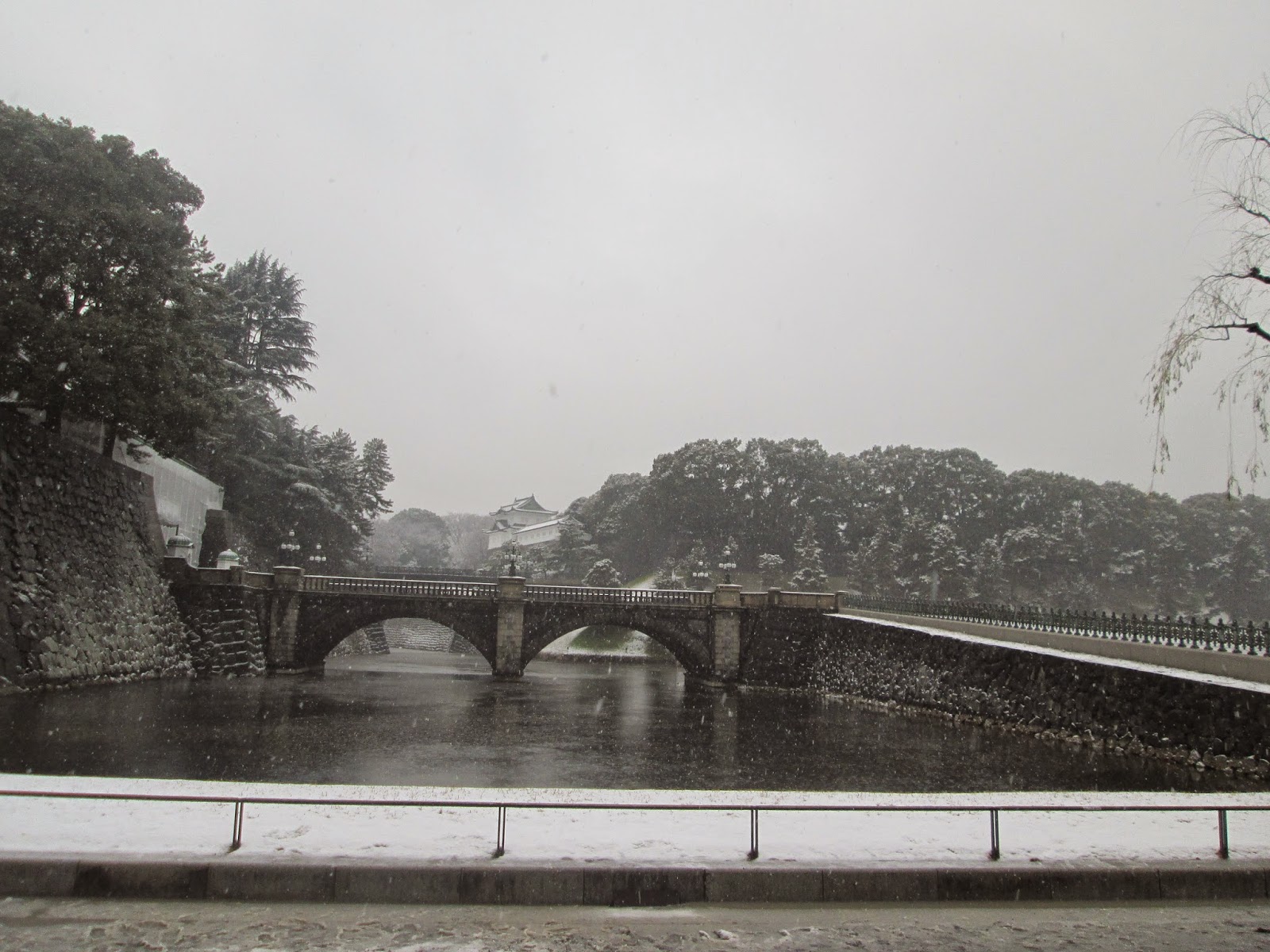
Nijubashi Bridge, Imperial Palace
Nijubashi Bridge, entrance to inner grounds of the Imperial Palace, in Tokyo. It was cold and snowing when we visited. The public isn't allowed into the main grounds except for Jan. 2 and Dec. 23 (we were there on Jan 30). The Palace is where the Imperial family resides, and is surrounded by walls (left) and a moat. Photo by Shutaro Akishino.
Kokyo Gaien National Gardens, Tokyo, Japan
A view of Tokyo from the Kokyo Gaien National Gardens,which surround the Imperial Palace. The backdrop of the city across the black pines and snow-covered lawns was breathtaking!
Black pine tree in the Kokyo Gaien National Gardens, Tokyo, Japan
The black pine trees in the Kokyo Gaien National Gardens had very interesting shapes, and provided a beautiful and stark contrast to the snow! Photo by Shutaro Akishino.
This sign indicates how close the famous bridge on the Imperial Palace grounds is to Tokyo Station.
Tokyo Station
We caught a subway at Tokyo Station, which is the busiest in Japan in terms of number of trains per day (over 3000). It is in the Marunouchi District in Chiyoda, Tokyo, within easy walking distance from the Imperial Palace.
purana barca pizzeria and bar, Tokyo, Japan
Our first meal in Tokyo, at the Purana Barca Pizzeria and Bar. Very nice restaurant and friendly staff! Bert McCarty is on the left, with our wonderful Japanese hosts from Toyo Green (left to right): Shoichi Kimura, Taro Fujiwara, Yuichiro Tsuchida, and Shutaro Akishino.
Chichibunomiya Rugby Stadium, Tokyo, Japan
Bert McCarty (left), Mika Seta (center), me (right), and Taro Fujiwara (facing away from camera), visiting on the grounds of Chichibunomiya Rugby Stadium, in Tokyo. The buildings in the background were built after the stadium was already there, and have caused a severe shade problem for the turfgrass (bermudagrass) growth. Photo by Shutaro Akishino.
Nakamise Dori Street, Asakusa, Tokyo
A view down the bustling, shop-lined street named Nakamise that leads to the main gate of Sensoji Temple, which is a famous Buddhist Temple. This is in the Asakusa district, where an atmosphere of the Tokyo of past decades survives. Bert McCarty stands a bit taller than the average Japanese! It was raining just enough to need the umbrellas.
Pagoda near the Sensoji Temple, Asakuse, Tokyo, Japan
This many-tiered pagoda came into view as we walked down Nakamise street towards Sensoji Temple. Japan is about 71% Buddhist, 84% Shinto, and only 2% Christian; many people belong to both Buddhism and Shintoism.
Sensoji Temple
The famous Sensoji Temple in Asakusa, Tokyo. The snow, which had been falling all morning, had built up on the steep roof and was sliding down and falling in huge chunks onto the sidewalk and steps leading into the temple (at far left). The police were trying to keep people from walking under the eve so they wouldn't get hurt!
Narrow streets in the Asakusa shopping district, Tokyo, Japan
Narrow streets in the Asakusa shopping district, near the Sensoji Temple.
Narrow streets in the Asakusa shopping district, Tokyo, Japan
Shin-Nakamise, or "New Nakamise", a covered shopping archade in Asakusa. The covered street was a welcome reprieve from the cold rain that was falling outside. Many Japanese wore surgical masks when out in public, apparently to protect themselves from sickness (or maybe to protect others if they were sick).
Two-wheeled, pulled rickshaw in Asakusa, Tokyo, Japan
We saw several two-wheeled rickshaws in Asakusa, which were pulled by a person!
Tokyo Skytree, disappearing into the clouds. Japan
We were excited to go up into the Tokyo Skytree, which is the tallest tower in Japan and second-tallest structure in the world. Unfortunately it was cloudy, so we didn't go. But it was amazing to look up and see it disappear into the clouds!
Tsukiji Fish Market, Tokyo, Japan
Assortment of fish, squid, and shellfish at the famous Tsukiji Fish Market in Tokyo.We got up at 4:30 am to see the fish auction but were too late. Admittance is strictly regulated and you had better get there earlier than we did (maybe 3 am) if you really want a spot. We were disappointed, but enjoyed walking around and looking at the fish and bustling activity as shop owners prepared for a busy Friday at the Market.
A shopkeeper slices product in preparation for the day, while a tuna appears to look on from the icebox!
Tsukiji Fish Market, Tokyo, Japan
Shutaro (center left) and me walking the narrow streets of the Tsukiji Fish Market at 5:30 am on a Friday. These shopkeepers get up very early and work hard to make a living!
I couldn't resist stopping by this tuna along the street. I love tuna and had no idea they were this big! I was told this wasn't even a large tuna. Shutaro liked to ham it up for the camera, and here he proudly presents the tuna!

Tokyo Tower, near the Zojoji Temple, Tokyo, Japan
A view of the Tokyo Tower from the nearby Zojoji Temple (Buddhist) in Tokyo. Tokyo Tower is 1,093 ft tall and is the second tallest structure in Japan.
The shadow of Tokyo Tower falls across this nearby soccer stadium on a beautiful Saturday morning in Tokyo.
Authentic sushi, Tokyo, Japan
This colorful and delicious sushi was definitely authentic. It was in a nice restaurant near the Tokyo Tower. Most of the sushi was raw (not cooked), which is something I wasn't use to. I ate more raw meat in my 6 days in Tokyo than I ever had before, but it was good to expand my culinary horizons!
My debut with the audience at the Toyo Green conference for golf course superintendents. They were very gracious and I really enjoyed presenting to them. Photo by Shutaro Akishino.
This was immediately after the 2-day conference. From left to right: Kibow, who translated our talks into Japanese; Bert McCarty, me; and Takao (Tak) Yamada, the president of Toyo Green Co. I am so grateful for their invitation to present at their conference! Photo by Shutaro Akishino.
Tokyo Skytree, as viewed from the Tokyo Tower, Japan
A view of the Tokyo Skytree from the Tokyo Tower. We wanted to go to the Skytree but it was closed because of high winds. Nevertheless, we weren't disappointed by the views from Tokyo Tower! Photo by Shutaro Akishino.
A stunning view of Tokyo Bay from the Tokyo Tower. It was very windy on the day we went up in the Tower, and we could feel it sway in the wind! The Zojoji Temple Grounds are in the foreground (bottom).

 Footnotes:
(1) Here is Toyo Green's website for the conference: http://www.toyo-green.com/english/turf-seminar.html